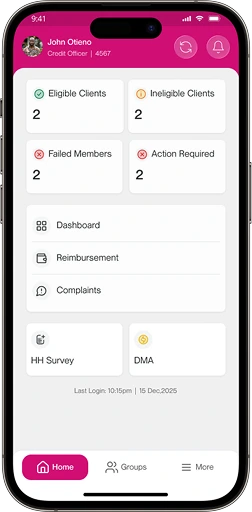
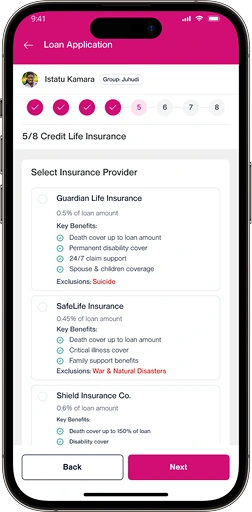
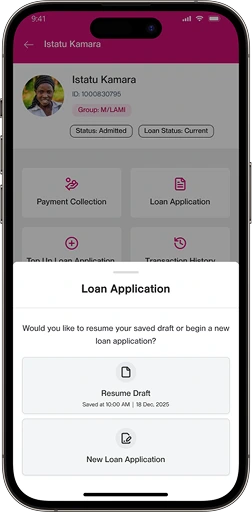
An end-to-end micro-finance tool for BRAC Kenya's field officers — designed to work where the network doesn't, and to turn hours of paperwork into minutes.
BRAC's field officers travel hours by motorbike to reach borrowers in rural Kenya — then record every loan, repayment and visit on paper.
That paper became a bottleneck: data was re-keyed at branch offices days later, errors crept in, and officers spent more time on admin than with the people they served. The Digital Field Assistant set out to put a complete, dependable workflow into their hands — one that never assumes a connection.
I led the work from contextual research in the field through to a production-ready interface and engineering handoff, designing for low-end Android tablets, bright sunlight, and intermittent power.
The constraints were unforgiving. Connectivity dropped for hours at a time. Officers wore gloves, worked one-handed, and squinted at screens in direct sun. A single mistyped repayment could cascade into a borrower's credit record.
Early in research three problems surfaced again and again — and they shaped every decision that followed.
Any flow that paused to sync would strand an officer mid-visit. Everything had to work fully offline and reconcile silently later.
Officers juggle dozens of borrowers per day. The interface had to surface the next action, not a dashboard of options.
Money is involved. Confirmation, legible numbers and reversible actions weren't polish — they were the product.
"If it stops working when the signal drops, it stops working — full stop."
We restructured the officer's day into a guided route. Each borrower visit became a self-contained flow that captured everything locally and queued it for sync — invisibly, the moment a signal returned.
A local-first store with conflict-safe sync meant officers never waited and never lost work.
Progressive disclosure stripped each step to its essential action, with high-contrast type sized for sunlight.
Every money movement showed a plain-language summary and stayed reversible until end of day.
Tokens and components were handed off ready to extend across BRAC's wider microfinance suite.
After a phased rollout across pilot branches, the Digital Field Assistant cut administrative time sharply and all but eliminated re-keying errors — freeing officers to spend their day with borrowers instead of forms.
Have a project in mind? I'm available for freelance work and open to new opportunities.